

Androctonus kunti sp. n. from Iğdır Province, Turkey (Scorpiones: Buthidae)
- Özgün Sipahioğlu
- Oct 24, 2024
- 18 min read

Euscorpius
Occasional Publications in Scorpiology
EDITOR: Victor Fet, Marshall University, ‘fet@marshall.edu’ ASSOCIATE EDITOR: Michael E. Soleglad, ‘msoleglad@gmail.com’
TECHNICAL EDITOR: František Kovařík, ‘kovarik.scorpio@gmail.com’
Euscorpius is the first research publication completely devoted to scorpions (Arachnida: Scorpiones). Euscorpius takesadvantage of the rapidly evolving medium of quick online publication, at the same time maintaining high research standards for the burgeoning field of scorpion science (scorpiology). Euscorpius is an expedient and viable medium for the publication of serious papers in scorpiology, including (but not limited to): systematics, evolution, ecology, biogeography, and general biology of scorpions. Review papers, descriptions of new taxa, faunistic surveys, lists of museum collections, and book reviews are welcome.
Derivatio Nominis
The name Euscorpius Thorell, 1876 refers to the most common genus of scorpions in the Mediterranean region and southern Europe (family Euscorpiidae).
Euscorpius is located at: https://mds.marshall.edu/euscorpius/Archive of issues 1-270 see also at: http://www.science.marshall.edu/fet/Euscorpius
(Marshall University, Huntington, West Virginia 25755-2510, USA)
ICZN COMPLIANCE OF ELECTRONIC PUBLICATIONS:
Electronic (“e-only”) publications are fully compliant with ICZN (International Code of Zoological Nomenclature) (i.e. for the purposes of new names and new nomenclatural acts) when properly archived and registered. All Euscorpius issues starting from No. 156 (2013) are archived in two electronic archives:
• Biotaxa, http://biotaxa.org/Euscorpius (ICZN-approved and ZooBank-enabled)• Marshall Digital Scholar, http://mds.marshall.edu/euscorpius/. (This website also archives all Euscorpius issues
previously published on CD-ROMs.)
Between 2000 and 2013, ICZN did not accept online texts as “published work” (Article 9.8). At this time, Euscorpius was produced in two identical versions: online (ISSN 1536-9307) and CD-ROM (ISSN 1536-9293) (laser disk) in archive-quality, read-only format. Both versions had the identical date of publication, as well as identical page and figure numbers. Only copies distributed on a CD-ROM from Euscorpius in 2001-2012 represent published work in compliance with the ICZN, i.e. for the purposes of new names and new nomenclatural acts.
In September 2012, ICZN Article 8. What constitutes published work, has been amended and allowed for electronic publications, disallowing publication on optical discs. From January 2013, Euscorpius discontinued CD-ROM production; only online electronic version (ISSN 1536-9307) is published. For further details on the new ICZN amendment, see
Publication date: 22 May 2023 http://zoobank.org/urn:lsid:zoobank.org:pub:C5304878-66F6-48A4-BD5E-0C7546C945A3
Euscorpius - Occasional Publications in Scorpiology. 2023, No. 371 Androctonus kunti sp. n. from Iğdır Province, Turkey
(Scorpiones: Buthidae) Ersen Aydın Yağmur
Manisa Celal Bayar University, Alaşehir Vocational School, Alaşehir, Manisa, 45600 Turkey. e-mail: ersen.yagmur@gmail.com
Summary
A new species Androctonus kunti sp. n. is described and illustrated from Iğdır Province of Turkey. This population was first recorded by Birula (1896) as A. crassicauda (Olivier, 1807). A. kunti sp. n. is compared with A. crassicauda as well as A. turkiyensis Yağmur, 2021, which was recently described from Turkey.
Introduction
The species Androctonus crassicauda was described from Kashan (Iran) as Scorpio crassicauda by Olivier (1807). After its description, many populations of Androctonus in the Middle East were included in this species. Currently, A. crassicauda is known from Armenia, Azerbaijan, Bahrain, Egypt (Sinai), Iran, Iraq, Israel, Jordan, Kuwait, Oman, Saudi Arabia, Syria, Turkey, United Arab Emirates, and Yemen (Fet & Lowe, 2000; Hendrixson, 2006).
The first record of A. crassicauda from Iğdır Province of Turkey was given by Birula (1896). Subsequently it was reported from many provinces of Turkey: Adıyaman (Crucitti, 1999), Batman (Yeşilyurt, 2005), Diyarbakır, Şanlıurfa (Penther, 1912), Gaziantep (Yağmur, 2005), Elazığ (Palu), İzmir, Malatya, Mersin (İçel) (Vachon, 1947), Kilis (Yağmur et al., 2007), Mardin (Werner, 1902), Kars, Siirt, Şırnak (Yağmur et al., 2008). Among these populations, Yağmur (2021) recently reviewed the Şanlıurfa population and described A. turkiyensis.
Birula (1896) reported the Androctonus population of Iğdır Province (as Prionurus crassicauda) for the first time from surroundings of Mt. Ararat. Birula (1904) confirmed this record and also reported another one from the Tuzluca District of Iğdır Province (under the name Kuljp). Yağmur et al. (2008) confirmed this record from Central District of Iğdır Province, also as A. crassicauda.
In this study, the Androctonus population from the Iğdır Province is examined, and described as a new species A. kunti sp. n., compared to Androctonus crassicauda and A. turkiyensis.
Material and Methods
Specimens of A. kunti sp. n. were collected under stones and during night using ultraviolet light from the Iğdır and Kars Provinces in between 04.06.2004 and 18.07.2022. The collected scorpion specimens were preserved in 96% alcohol. Photographs were taken with the method in Yağmur (2021). The trichobothrial nomenclature after Vachon (1974) and morphological nomenclature after Francke (1977), Stahnke (1971) and Hjelle (1990). The morphological measurements are given in millimeters (mm) according to Sissom et al. (1990). The type specimens of A. kunti sp. n. were deposited in Alaşehir Zoological Museum, Manisa Celal Bayar University, Alaşehir, Manisa, Turkey (AZMM).
Systematics Androctonuskuntisp.n. (Figures 1–76; Table 1)
Prionurus crassicauda: Birula, 1896: 232 (part); Birula, 1904: 29 (part).
Androctonus crassicauda: Yağmur et al., 2008: 14.
Type locality and type depository. Turkey, Iğdır, Central District, Melekli Village, 5 km SE, 39°55'00"N 44°08'15"E, 899 m a. s. l.; AZMM.
Type material examined. Turkey, Iğdır Province, Iğdır,
2
Euscorpius - 2022, No. 347
Dimensions (mm) | Androctonus kunti sp. n. ♂ holotype | Androctonus kunti sp. n. ♀ paratype | |
Carapace Mesosoma Tergite VII Metasoma + telson Segment I Segment II Segment III Segment IV Segment V Telson Pedipalp Femur Patella Chela Manus Fixed Finger Movable finger | L/ W L L/ W L L/ W L/ W L/ W L/ W L/ W L/ W / D / D / D / D / D / D LL/ W L/ W LL/ W / D LL | 9.47 / 9.66 22.705.84 / 9.25 48.176.41 / 6.42 / 5.55 7.17 / 6.83 / 6.02 7.57 / 7.19 / 6.59 9.08 / 7.21 / 6.27 9.45 / 6.52 / 4.03 8.49 / 3.25 / 2.87 33.437.90 / 3.34 9.41 / 3.48 16.125.87 / 3.59 / 3.95 8.3010.48 | 10.29 / 11.57 23.714.89 / 11.69 50.866.21 / 7.00 / 6.72 7.42 / 7.26 / 7.16 8.02 / 7.73 / 7.66 9.38 / 7.77 / 7.29 9.54 / 7.02 / 4.55 10.29 / 3.99 / 3.31 35.528.29 / 2.67 9.84 / 3.74 17.396.61 / 3.95 / 4.25 9.4211.60 |
Total | L | 80.34 | 81.86 |
Table 1. Comparative measurements of Androctonus kunti sp. n. male holotype and female paratype. Abbreviations: length (L), width (W, in carapace it corresponds to posterior width), depth (D).
Central District, Melekli Village, 5 km SE, 39°55'00"N 44°08'15"E, 899 m a. s. l., 16.VII.2011, 1♂ (holotype), leg. E. A. Yağmur & M. Özkörük (AZMM/Sco-2011:02); Aralık District, Yukarı Aratan Village, 39°49'56"N 44°32'16"E, 855 m a. s. l., 22.VII.2010, 1♂ (paratype), leg. E. A. Yağmur & M. Özkörük (AZMM/Sco-2010:1); Aralık District, TİGEM Farm, 39°47'08"N 44°37'09"E, 834 m a. s. l., 13.VII.2014, 1♂ (paratype), leg. A. Avcı (AZMM/Sco-2010:1), 29.VIII.2021, 1♂1♀ (paratypes), leg. E. A. Yağmur & Ö. Sipahioğlu (AZMM/ Sco-2021:20-21); Central District, 12th km of Doğu Beyazıt Road, 39°47'16"N 44°07'43"E, 1326 a. s. l., 4.VI.2004, 1juv. (paratype), leg. M. Kesdek (AZMM/Sco-2004:19); Central District, Melekli Village, 5 km E, 39°55'58"N 44°08'01"E, 4.VI.2007, 1♀ (paratype), leg. H. Koç, A.V. Gromov (AZMM/ Sco-2007:8), 19.VII.2011, 1♂ (paratype), E. A. Yağmur & M. Özkörük (AZMM/Sco-20011:16); Central District, Melekli Village, 5 km SE, 39°55'00"N 44°08'15"E, 899 m a. s. l., 16.VII.2011, 7♂2♀2juvs. (paratypes), leg. E. A. Yağmur & M. Özkörük (AZMM/Sco-20011:05-15), 7.VII.2012, 2♂ (paratypes), leg. E. A. Yağmur & H. Koç (AZMM/Sco- 2012:01-2), 27.VIII.2022, 1♂ (paratype), leg. E. A. Yağmur & Ö. Sipahioğlu (AZMM/Sco-2021:19); Central District, Melekli Village, 4 km Northeast., 39°57'04"N 44°08'24"E, 862 m a. s. l., 18.VII.2022, 5♂2♀ (paratypes), leg. E. A. Yağmur, Ö. Sipahioğlu & İ. Kartal (AZMM/Sco-2022:03-9); Central District, Suveren Village, 39°48'11"N 44°03'47"E, 1212 m a. s. l., 15.VIII.2019, 2♂1♀ (paratypes), leg. B. Akman (AZMM/ Sco-20011:01-3); Kars Province, Digor District, Halıkışlak Village, 40°09'06"N 43°39'16"E, 985 m a. s. l., 3.VI.2004, 1♂ (paratype), M. Kesdek (AZMM/Sco-2004:20).
Etymology. The species epithet is a patronym dedicated to Kadir Boğaç Kunt, a friend of the author and Turkish arachnologist, who has made great contributions to the knowledge of the spider fauna and systematics in Turkey.
Diagnosis (♂♀). All body is dark brownish black to uniformly black, except of chela fingers, anterior segments of the legs, pectins and sternites III-V. Fingers dark yellow to dark brown. Tarsi dark yellow, basitarsus and pretarsus brown. Aculeus reddish brown. Pectens and poststernites of III-V are dark yellow. Medium-big sized scorpions. Holotype male size is in 85.48 mm and female paratypes is in 70,10 mm. Fixed and movable fingers with 15–17 and 14–16 principal rows of denticles, respectively. Carapace moderately covered with moderate and rounded granules in males, moderately covered with small granules in females, the granules on anterior and on the carinae coarse and rounded in both sexes. Posttergites moderately covered with rounded and moderate sized granules on tergites I-VI, the granules flattened in females. Ventrolateral carinae of metasomal segment I-IV strong and big rounded granules. Ventrolateral carinae of metasomal segment V with gradually increased granules posteriorly. Males have four non-spaced large and partly pointed denticles, posterior one smaller than others and females have three non-spaced large and partly pointed denticles, posterior one smaller than others. Denticles in the females are bigger than in the males. Dorsolateral carinae of metasomal segment rounded with very swollen and big granules anteriorly, without granules posteriorly. Dorsolateral carinae of segment III-IV strong with moderate,

Figures 1–4: A. kunti sp. n. Figures 1–2. Male holotype in dorsal (1) and ventral (2) views. Figures 3–4. Female paratype in dorsal (3) and ventral (4) views. Scale bar: 10 mm.

Figures 5–6: A. kunti sp. n., male holotype under white light. Figure 5. Carapace and tergites in dorsal view. Figure 6. Sternites and sternopectinal area. Scale bar: 10 mm.
rounded granules, gradually increase posteriorly and two are big posteriorly. Anal arch with two large round lobes on lateral, the inferior one is twice as big; slightly divided in females. Pectines with 31–35 teeth in males, and 25–27 in females. Chela manus wider than patella (Average chela width/patella width ratio=1.19 in males (n=6), 1.19 females (n=6)); fingers are moderately elongated (Average movable finger length/manus length ratio=1.88 in males (n=6), 1.84
in females (n=6) and chela length/manus width ratio=3.94 in male (n=6), 4.73 in female (n=6)), evenly curved.
Description (based on male holotype)Coloration (Figs. 1–2, 75). All body is dark brownish black to uniformly black. Fingers dark yellow to dark brown posteriorly. Tarsi of legs, pectens and poststernites of III-V are yellow, basitarsus and pretarsus brown. Sternum, genital
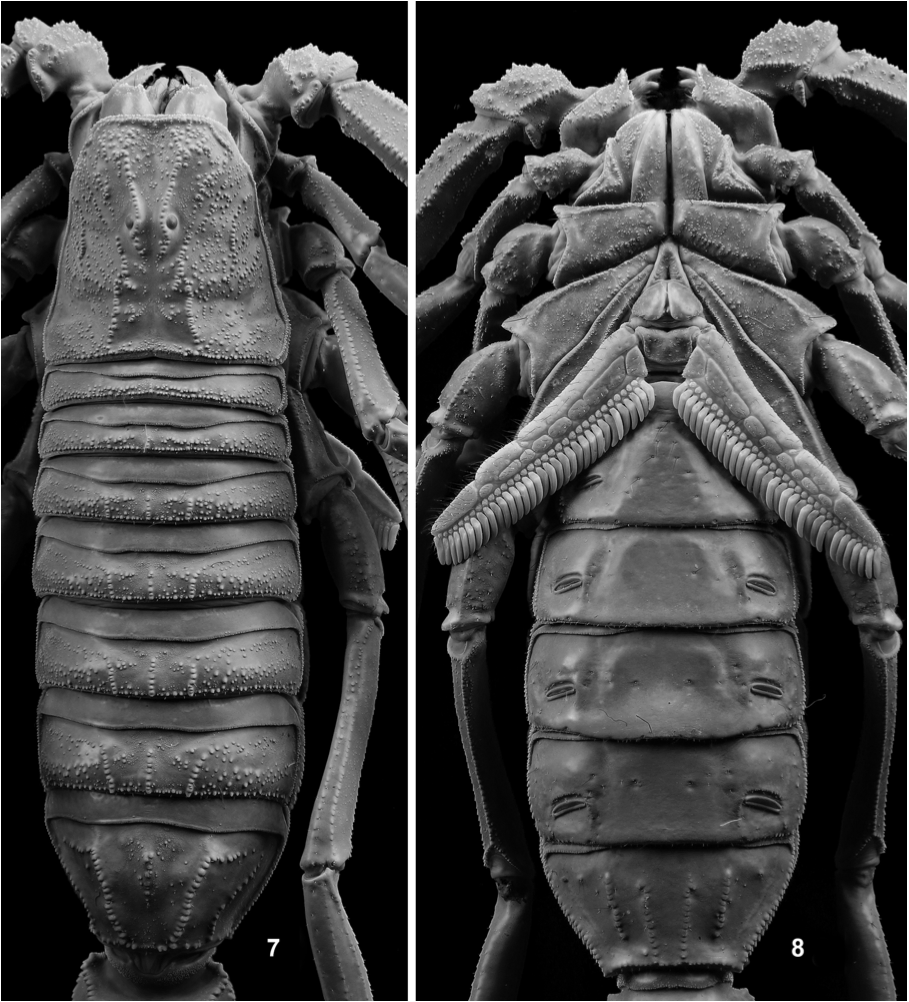
Figures 7–8: A. kunti sp. n., male holotype under UV light.
Figure 7. Carapace and tergites in dorsal view. Figure 8. Sternites and sternopectinal area. Scale bar: 10 mm.
operculum, and basal plate brown. Aculeus reddish brown, dark red distally.Prosoma (Figs. 5–12). Trapezoidal, slightly wider than long; anteriomedian, posteriomedian and centromedian carinae strongly, centrolateral carinae moderately granular, intercarinal area covered with medium sized granules, but
anterior area with coarse and flattened granules; anterior margin nearly straight, with some of stout and a few long macrosetae; median eyes are separated by about three ocular diameters. There are five pairs of lateral eyes, three large and two vestigial. Anterior margin with medium flattened, posterior with margin small granule rows.

Figures 9–12. A. kunti sp. n., carapace with tergites I–II (9, 10) and sternopectinal area (11, 12) of male holotype under white light (9, 11) and under UV light (10, 12).
Chelicerae. Dentition is typical for the genus; surface of manus reticulated, smooth with possesses small, rounded granules arranged in longitudinal ridges.
Pedipalps (Figs. 21–36). Pedipalps slender, moderately long and sparsely setose. Trichobothrial pattern is Type A, orthobothriotaxic. Dorsal trichobothria of femur are arranged

Figures 13–14: A. kunti sp. n., female paratype under white light.
Figure 13. Carapace and tergites in dorsal view. Figure 14. Sternites and sternopectinal area. Scale bar: 10 mm.
in beta-configuration with d2 located on dorsal surface. Femur pentacarinate; slender and straight; all carinae strong and granulose, granules moderate and pointed; dorsointernal carinae serrated with spaced and spinoid granules; intercarinal tegument finely granulose with irregular moderate granules
dorsally, inner surface with few coarse granules. Patella with seven carinae, slender and straight; all carinae moderate; ventrointernal, ventromedian, dorsointernal, dorsomedian and dorsoexternal carinae granulose, granules moderate and rounded; ventromedian and ventrointernal carinae nearly

Figures 15–16: A. kunti sp. n., female paratype under UV light. Figure 14. Carapace and tergites in dorsal view. Figure 16. Sternites and sternopectinal area.
smooth. Dorsointernal and ventrointernal carinae with one spinoid granule distally. Surfaces smooth covered with fine granules densely.
The chela is rough and lustrous covered with some microgranules, without carinae; internal surface covered fine granules densely. Chela manus wider than patella (Chela

Figures 17–20. A. kunti sp. n., carapace with tergites I–II (17, 18) and sternopectinal area (19, 20) of female paratype under white light (17, 19) and under UV light (18, 20). Scale bar: 10 mm.

Figures 21–28. A. kunti sp. n., male holotype, pedipalp segments. Chela ventral (21), dorsal (22), internal (23) and external (24) views. Movable (25) and fixed (26) fingers dentition. Pedipalp ventral (27), dorsal (28). Trichobothrial pattern is indicated by red circles. Scale bar: 10 mm.

Figures 29–36. A. kunti sp. n., male holotype, pedipalp segments, under UV light. Chela ventral (29), dorsal (30), internal (31) and external (32) views Movable (33) and fixed (34) fingers dentition. Pedipalp ventral (35), dorsal (36). Scale bar: 10 mm.

Figures 37–44. A. kunti sp. n., female paratype pedipalp segments. Chela ventral (37), dorsal (38), internal (39) and external (40) views Movable (41) and fixed (42) fingers dentition. Pedipalp ventral (43), dorsal (44). Trichobothrial pattern is indicated by red circles. Scale bar: 10 mm.

Figures 45–52: A. kunti sp. n., female paratype, pedipalp segments under UV light. Chela ventral (45), dorsal (46), internal (47) and external (48) views Movable (49) and fixed (50) fingers dentition. Pedipalp ventral (51), dorsal (52). Scale bar: 10 mm.

Figures 53–58: A. kunti sp. n., metasoma and telson of male holotype. Figures 53–55: Under white light, lateral (53), dorsal (54), and ventral (55) views. Figures 56–58: Under UV light, lateral (56), dorsal (57), and ventral (58) views. Scale bar: 10 mm.

Figures 59–64: A. kunti sp. n., metasoma and telson of female paratype. Figures 59–61: Under white light, lateral (59), dorsal (60), and ventral (61) views. Figures 62–64: Under UV light, lateral (62), dorsal (63), and ventral (64) views. Scale bar: 10 mm.
width/Patella width=1.03); fingers are moderately elongated (movable finger length/manus length ratio=1.78 and chela length/manus width ratio=4.49), evenly curved. The movable fingers of pedipalps bear 16 rows of denticles, external and internal accessory denticles exist, with three distal granules; the fixed fingers bear 15 rows of denticles, with external and internal accessory denticles exist. Trichobothrium et is located between est and dt, trichobothrium db is located between est and esb; trichobothrium et proximal to dt, trichobothrium est proximal to db.
Sternum standard for the genus: type 1, triangular.
Pectines long (reaching middle of leg trochanter) and narrow with dense macrosetae; tooth count 33/33; basal plate heavily
sclerotized. Surface of coxa plates moderately covered fine granules, margins of coxa plates with dense fine granules.
Mesosoma (Figs. 5–8). Posttergites moderately covered with rounded and moderate sized granules, pretergites covered with small sized granules on tergites I-VI; posterior margins of tergites I-VI with a row of moderate sized pointed granules; tergites I-VI with strong and granulose three carinae (median and submedians), slightly projected beyond posterior margin; intercarinal area smooth but between submedian carinae with microgranules. Tergite VII with coarsely granular five carinae (median, submedians and laterals), surround median carina with some small granules and microgranules. Sternites with very sparsely macrosetae; III–VI smooth and lustrous,

Figure 73. A. kunti sp. n., male holotype, tibia, basitarsus and tarsus of right legs I–IV.
and spiracles very elongate and slit-like without granulation; III without carinae, IV–VI with a pair of lateral carinae, on IV–V smooth and VI finely granular; VII with two pairs of moderately granular carinae.
Metasoma and telson (Figs. 53–58, 65, 67, 69, 71). Metasoma very sparsely setose. Segment I very slightly wider than long; segment II–V longer than wide; all segments wider than deep. Widths of segment I–IV gradually increase posteriorly.
Intercarinal tegument of dorsal surface smooth and without granulation, lateral surface smooth with scattered fine granules and dorsal surface smooth with moderately dense fine granules and scattered big granules on segments I–V; dorsal furrow moderately wide and deep on segments I-V. Segments I-III with ten carinae, segment IV with eight, and V with five carinae; lateral inframedian carinae complete and moderate on segment I, present on posterior quarter, weak, with 2-3 coarse

Figure 74. A. kunti sp. n., female paratype, tibia, basitarsus and tarsus of right legs I–IV (Presumably the long macrosetae of bristle combs have worn or broken off in the photographed female specimen).
granules on segments II-III. Dorsolateral carinae strong and granules gradually enlarge posteriorly on I–IV; the granules moderate and rounded on segments I-II; large, pointed and serrated on segments III-IV, posteriorly smooth and very rounded shallow granules anteriorly on segment V. Lateral supramedian carinae strong on segments I–IV with coarse and rounded granules. Ventrolateral carinae on segments I–IV strong, with coarse and rounded granules; strong on segment V and gradually increase posteriorly, with partly pointed, non- spaced 4 large denticle. Ventral submedian carinae moderate on I–IV, with coarse, rounded granules. Ventromedian carina moderate on V with coarse and rounded granules. Anal arch with two large round lobes on lateral, the inferior one is twice as big; 13-14 very small and very rounded granules posteriorly. Telson slender and sparsely setose (telson length/width=2.61, telson width/depth=1.13); vesicle small and somewhat globose, narrower than segment V with not distinct and bear flattened granules ventromedian carinae; surface glossy and smooth, with some flattened coarse granules; subaculear setal pair exist; aculeus long and thick but shorter than vesicle
(vesicle length/aculeus length=1.12) and evenly curved.Legs (Figs. 73). Legs long, slender, and only moderately setose. Basitarsus of legs I to III with bristlecombs; basitarsus of legs IV without bristlecombs. Tibial spurs exist on legs III and IV. Tarsus of legs I–IV ventrally with spine-like setae arranged in two rows.
Measurements. See Table 1.
Affinities(a) General coloration is brown or dark brown in A. turkiyensis (see Yağmur, 2021, figures 1-4), whereas black in A. kunti sp. n. (b) Ventrolateral carinae of metasomal segment V with spaced 2-3 large denticles in A. turkiyensis (see Yağmur, 2021, figures 19, 22, 25, 28, 33, 36, 70), whereas non-spaced 3-4 large denticles in A. kunti sp. n. and without large denticles in A. crassicauda.(c) Dorsolateral carinae rounded with very swollen and large granules anteriorly on segment V in A. kunti sp. n., whereas serrated anteriorly and pointed granules in A. crassicauda (see Yağmur, 2021, figures 69).

Figures 75–76: Alive specimens of A. kunti sp. n. in the natural habitat. Figure 75. Male. Figure 76.Female.
(d) Dorsolateral carinae of segments III-IV serrated with moderate and rounded granules, granule size gradually increased posteriorly, whereas A. crassicauda has large, pointed and comb-like granules, and granule size is gradually increased posteriorly (see Yağmur, 2021, figures 69).
(e) Intercarinal area on carapace coarse granules in A. turkiyensis (see Yağmur, 2021, figures 13-16), whereas A. kunti sp. n. has smaller granules.(f) A. turkiyensis has stockier chela (see Yağmur, 2021, figures 40, 54) than A. kunti sp. n. Chela length/manus width ratio is
3.98 in male holotype of A. turkiyensis, whereas 4.49 in male holotype of A. kunti sp. n.(g) Trichobothrium et is located between est and dt in A. kunti sp. n., whereas trichobothrium et nearly opposite to trichobothrium dt in A. turkiyensis (see Yağmur, 2021, figures 40, 54).
Comments on locality and life strategy. According to my observations, this species is xerophilic (Figs. 77–78). The Iğdır Province has low elevation and a hot climate in summer.

Figures 77–78. Habitats of A. kunti sp. n. in the foothills of Мt. Ararat. Figure 77. Sand dunes habitat. Figure 78. Sandy calcareous soil and basaltic rocky habitats.

Figure 79. A. turkiyensis and A. kunti sp. n. distribution map. Blue circle indicates type locality and red circles indicate other collection localities of A. kunti sp. n. The region marked in red is the known range of A. turkiyensis.
The collection localities are arid places, and eremial lizard species Eremias pleskei and Phrynocephalus horvathi are observed in sand dune habitats in Aralık District. Specimens were collected between 855–1326 m elevations. The habitats are in a volcanic area. Therefore, they include abundant basaltic stones and rocks. In addition, there are some sand dunes formed due to erosion including grasses or somlatha shrub (Ephedra distachya) (Zeynalov & Türkoğlu, 2016). The new species was collected under stones and entrances of lateral rock crevices in hard calcareous soil or sand dune habitats, and one specimen was collected in a burrow in the sand dune habitat. Similarly, Yağmur (2021) reported that A. turkiyensis was collected under stones and entrances of lateral rock crevices in steppe areas. Crucitti (2003) reported that A. turkiyensis (as A. crassicauda) searches for prey by wandering on the soil surface, inside and outside walls of buildings. He also reported that this species hunted by “sit and wait” or “ambush hunter” methods. Yağmur (2021) reported similar observations on A. turkiyensis. During the night field trips, some specimens of A. kunti sp. n. were observed in the same position in the basaltic rock crevices or under big basaltic stones. When I tried to catch them, they couldn’t be caught because they retreated into shelter. A. kunti sp. n. was collected sympatrically with Olivierus caucasicus in Suveren Village. This species inhabits stone crevices like A. kunti sp. n. and a dense population was found in this locality. It was also collected with O. caucasicus and Mesobuthus eupeus in the localities around Melekli Village and in Aralık District. These localities are generally open areas and rocky areas are less common. O. caucasicus had low density in these localities; on the other hand, these places have very dense M. eupeus populations.
The Iğdır Province is located in the Eastern Anatolian Region of Turkey. Although Iğdır Province has low elevation, Eastern Anatolia Region is a highland region. Altitudes increase abruptly in western sites of the province. Therefore, Iğdır Province includes eremial species but some of these species cannot penetrate inner places of Anatolia due to high altitudes. Probably Olivierus caucasicus and Mesobuthus eupeus have higher ecological tolerance therefore they are distributed in some other places in Caucasus in higher altitudes. However, A. kunti sp. n. prefers arid habitats and cannot penetrate the Eastern Anatolian Region of Turkey. Birula (1896, 1904) reported that Prionurus crassicauda is distributed in Aras Valley (now between Turkey, Iran, Nakhichevan (Azerbaijan) and Armenia) and around Mt. Ararat. Aras Valley is a low altitude place and includes arid habitats and around Mt. Ararat there are sand dune habitats. For example, eremial lizards Eremias pleskei and Phrynocephalus horvathi are distributed along this region and their range overlaps with that of A. kunti sp. n. Distribution patterns of these species indicate that this area has a special eremial fauna (Ananjeva & Agasyan, 2009; Tuniyev et al. 2009). I consider that A. kunti sp. n. is adapted to this region like these lizard species and isolated in this region.
Yağmur (2021) recently described A. turkiyensis from Şanlıurfa Province in Southeastern Anatolian Region of Turkey. Probably other populations of Androctonus belonging to this species are present in Southeastern Anatolian Region. This region is located south of the Taurus-Zagros mountain range (Fig. 79). This mountain range already well separate A. turkiyensis and A. kunti sp. n. Moreover, the mountainous, and high-altitude Eastern Anatolia Region prevents the distribution of A. kunti sp. n. to inner places in Turkey. Kozár (1995) divided the Palaearctic region into four subregions which are Euro-Siberian, Mediterranean, Irano-Turanian and Far Eastern. According to Kozár (1995), the Mediterranean and Irano-Turanian subregions are divided by the Taurus- Zagros Mountains; therefore, A. turkiyensis and A. kunti sp. n. are found in different zoogeographic regions.
Acknowledgements
I wish to thank Alexander V. Gromov (Bingen am Rhein, Germany), Bahadır Akman (Iğdır Technical Sciences Vocational School, Iğdır University, Turkey), Halil Koç (Department of Biology, Sinop University, Turkey), Mehmet Özkörük (Gaziantep, Turkey), Memiş Kesdek (Fethiye Ali Sıtkı Mefharet Koçman Vocational High School, Muğla Sıtkı Koçman University, Turkey), Özgün Sipahioğlu (İstanbul, Turkey), İbrahim Kartal (İstanbul, Turkey) for their help in field trips. I am grateful to two anonymous reviewers for the comments that greatly improved the text.
References
ANANJEVA, N. & A. AGASYAN. 2009. Phrynocephalus horvathi. The IUCN Red List of Threatened Species 2009: e.T164759A5923724.
BIRULA, A. A. 1896. Miscellanea scorpiologica. I. Zur Synonymie der russischen Skorpione. Annuaire du Musee Zoologique de I’ Academie Imperiale des Sciences de St.- Petersbourg, 1: 229–245.
BIRULA, A.A. 1904. Miscellanea scorpiologica. VII. Synopsis der russischen Skorpione. Annuaire du Musee Zoologique de l’ Academie Imperiale des Sciences de St.- Petersbourg, 9: 28–38.
CRUCITTI, P. 1999. The scorpions of Anatolia: Bio- geographical patterns. Biogeographica, 20: 81–94.
CRUCITTI, P. 2003. Ricerche bio-ecologiche su Androctonus crassicauda nell’Anatolia sud-orientale. Bollettino della Società Entomologica Italiana, 135(1): 3–14.
FET, V. & G. LOWE. 2000. Family Buthidae C. L. Koch, 1837. Pp. 54–286 in Fet, V., W. D. Sissom, G. Lowe & M. E. Braunwalder. 2000. Catalog of the Scorpions of the World (1758–1998). New York: The New York Entomological Society, 689 pp.
FRANCKE, O. F. 1977. Scorpions of the genus Diplocentrus from Oaxaca, Mexico (Scorpionida, Diplocentridae). Journal of Arachnology, 4: 145–200.
HENDRIXSON, B. E. 2006. Buthid scorpions of Saudi Arabia, with notes on other families (Scorpiones: Buthidae, Liochelidae, Scorpionidae). Fauna of Arabia, 21: 33–120.
Euscorpius - 2023, No. 371
HJELLE, J. T. 1990. Anatomy and morphology. Pp. 9-63 in: Polis, G.A. (ed.), Biology of Scorpions. Stanford, CA: Stanford University Press.
KOZÁR, F. 1995. New data on the zoogeography of Palearctic Coccoidea (Homoptera). Israel Journal of Entomology, 29: 103–108.
OLIVIER, G. A. 1807. Voyage dans l’Empire Othoman, l’Egypte et la Perse. Henri Agasse, Paris, 5.
PENTHER, A. 1912. Wissenschaftliche Ergebnisse der Expedition nach Mesopotamien, 1910. Scorpiones. Annalen des Kaiserlich-Königlichen Naturhistorischen Hofmuseums in Wien, 26(1-2), 109–115.
SISSOM, W. D., G. A. POLIS, G. A. & D. D. WATT. 1990. Field and laboratory methods. Pp. 215–221 in: Polis, G.A. (ed.), Biology of Scorpions. Stanford, CA: Stanford University Press.
STAHNKE, H. L. 1971. Scorpion nomenclature and mensuration. Entomological News, 81: 297–316.
TUNIYEV, B., N. ANANJEVA, A. AGASYAN, N. ORLOV & S. TUNIYEV. 2009. Eremias pleskei. The IUCN Red List of Threatened Species 2009: e.T164583A5910262.
VACHON, M. 1947. Remarques préliminaires sur le faune des Scorpions de Turquie. Bulletin du Muséum national d’Histoire naturelle Paris, 19 (2): 161–164.
VACHON, M. 1974. Etude des caractères utilisés pour classer les familles et les genres de Scorpions (Arachnides). 1. La trichobothriotaxie en arach- nologie. Sigles trichobothriaux et types de trichobothriotaxie chez les Scorpions. Bulletin du Muséum national d’Histoire naturelle Paris, 140: 857–958.
WERNER, F. 1902. Die Scorpione, Pedipalpen und Solifugen in der zoologisch-vergleichend-anatomischen Sammlung der Universität Wien. Verhandlungen der kaiserlich- königlichen zoologisch-botanischen Gesellschaft in Wien, 52: 595–608.
YAĞMUR, E. A. 2005. Gaziantep akrepleri (Ordo: Scorpiones) ve zoocoğrafik dağılışları. Yüksek Lisans Tezi, Gaziantep Üniversitesi Fen Bilimleri Enstitüsü, Gaziantep. 136 s.
YAĞMUR, E. A. 2021. Androctonus turkiyensis sp. n. from the Şanlıurfa Province, Turkey (Scorpiones: Buthidae). Euscorpius, 341: 1–18.
YAĞMUR, E. A., H. KOÇ, S. KESMEZOĞLU & M. YALÇIN. 2007. Scorpions of Kilis Province, Turkey (Arachnida: Scorpiones), Serket, 10(3): 91–105.
YAĞMUR, E. A., M. YALÇIN & G., ÇALIŞIR. 2008. Distribution of Androctonus crassicauda (Olivier, 1807) and Buthacus macrocentrus (Ehrenberg, 1828) (Scorpiones: Buthidae) in Turkey, Serket. 11(1): 13–18.
YEŞİLYURT, F. 2005. Anadolu’daki Bazı Akreplerin Sistematiği ve Biyoekolojisi (Arachnida: Scorpionida). Kırıkkale Üniversitesi, Fen Bilimleri Enstitüsü, Yüksek Lisans Tezi. Kırıkkale. 80 s.
23
ZEYNALOV, Y. & M. TÜRKOĞLU. 2016. Ağrı Dağının Florası.T.C.OrmanveSuIşleriBakanlığıDoğaKoruma Ve Milli Parklar Genel Müdürlüğü, Ankara. 402 s.
*THIS PUBLICATION IS PUBLISHED ON:


Comments