

Androctonus turkiyensis sp. n. from the Şanlıurfa Province, Turkey (Scorpiones: Buthidae)

Updated: Mar 17, 2025
Euscorpius
Occasional Publications in Scorpiology
EDITOR: Victor Fet, Marshall University, ‘fet@marshall.edu’ ASSOCIATE EDITOR: Michael E. Soleglad, ‘msoleglad@gmail.com’
TECHNICAL EDITOR: František Kovařík, ‘kovarik.scorpio@gmail.com’
Euscorpius is the first research publication completely devoted to scorpions (Arachnida: Scorpiones). Euscorpius takesadvantage of the rapidly evolving medium of quick online publication, at the same time maintaining high research standards for the burgeoning field of scorpion science (scorpiology). Euscorpius is an expedient and viable medium for the publication of serious papers in scorpiology, including (but not limited to): systematics, evolution, ecology, biogeography, and general biology of scorpions. Review papers, descriptions of new taxa, faunistic surveys, lists of museum collections, and book reviews are welcome.
Derivatio Nominis
The name Euscorpius Thorell, 1876 refers to the most common genus of scorpions in the Mediterranean region and southern Europe (family Euscorpiidae).
Euscorpius is located at: https://mds.marshall.edu/euscorpius/Archive of issues 1-270 see also at: http://www.science.marshall.edu/fet/Euscorpius
(Marshall University, Huntington, West Virginia 25755-2510, USA)
ICZN COMPLIANCE OF ELECTRONIC PUBLICATIONS:
Electronic (“e-only”) publications are fully compliant with ICZN (International Code of Zoological Nomenclature) (i.e. for the purposes of new names and new nomenclatural acts) when properly archived and registered. All Euscorpius issues starting from No. 156 (2013) are archived in two electronic archives:
• Biotaxa, http://biotaxa.org/Euscorpius (ICZN-approved and ZooBank-enabled)• Marshall Digital Scholar, http://mds.marshall.edu/euscorpius/. (This website also archives all Euscorpius issues
previously published on CD-ROMs.)
Between 2000 and 2013, ICZN did not accept online texts as “published work” (Article 9.8). At this time, Euscorpius was produced in two identical versions: online (ISSN 1536-9307) and CD-ROM (ISSN 1536-9293) (laser disk) in archive-quality, read-only format. Both versions had the identical date of publication, as well as identical page and figure numbers. Only copies distributed on a CD-ROM from Euscorpius in 2001-2012 represent published work in compliance with the ICZN, i.e. for the purposes of new names and new nomenclatural acts.
In September 2012, ICZN Article 8. What constitutes published work, has been amended and allowed for electronic publications, disallowing publication on optical discs. From January 2013, Euscorpius discontinued CD-ROM production; only online electronic version (ISSN 1536-9307) is published. For further details on the new ICZN amendment, see http://www.pensoft.net/journals/zookeys/article/3944/.
Publication date: 16 November 2021 http://zoobank.org/urn:lsid:zoobank.org:pub:AE959240-FD45-454E-A065-1BCAD1C88799
Euscorpius - Occasional Publications in Scorpiology. 2021, No. 341 Androctonus turkiyensis sp. n. from the Şanlıurfa Province,
Turkey (Scorpiones: Buthidae) Ersen Aydın Yağmur
Manisa Celal Bayar University, Alaşehir Vocational School, Alaşehir, Manisa, 45600 Turkey. E-mail: ersen.yagmur@gmail.com
Summary
A new species Androctonus turkiyensis sp. n. is described and illustrated from the Şanlıurfa Province of Turkey. The new species is compared with A. crassicauda (Olivier, 1807), which was previously misidentified from Turkey. A. crassicauda specimens used for comparison were collected from Kashan County (Iran), the type locality of this species; a neotype from Kashan is designated.
Androctonus turkiyensis sp. n. from the Şanlıurfa Province, Turkey (Scorpiones: Buthidae)
Introduction
The species Androctonus crassicauda was described from Kashan (Iran) as Scorpio crassicauda by Olivier (1807). The genus Androctonus was established by Ehrenberg (1828), with Androctonus australis (L., 1758) as its type species. Simon (1872) moved Scorpio crassicauda to genus Buthus but Kraepelin (1891) classified it under the genus Androctonus for the first time. Soon after, Pocock (1895) moved it to genus Prionurus. This species for a long time was placed under Prionurus or subgenus Buthus (Prionurus) (Fet & Lowe, 2000) until Vachon (1948) moved it to Androctonus. The genus Androctonus currently includes 29 species found in North Africa, Middle East and western Asia (Fet & Lowe, 2000; Rein, 2021).
Androctonus crassicauda has been recorded from Armenia, Azerbaijan, Bahrain, Egypt (Sinai), Iran, Iraq, Israel, Jordan, Kuwait, Oman, Saudi Arabia, Syria, Turkey, United Arab Emirates, and Yemen (Fet & Lowe, 2000; Hendrixson, 2006). Birula (1900) described Prionurus crassicauda orientalis Birula, 1900 but this subspecies was synonymized with A. crassicauda by Levy and Amitai (1980). Vachon (1948) described A. crassicauda gonneti from Morocco but Lourenço (2005) elevated it to species level, and restricted A. crassicauda to the Middle East and western Asia. Apart from these, no studies have been not made to solve systematic position of A. crassicauda populations, although this species occupies a very wide geographic range.
The first record of A. crassicauda from Turkey was given by Birula (1904) from Iğdır Province (Tuzluca). Subsequently, it was recorded from the provinces of Diyarbakır (Vachon, 1947), Elazığ (Palu), Malatya, Mardin, Şanlıurfa (Vachon,
1951), İçel (Tolunay, 1959), Adıyaman (Crucitti, 1999; Crucitti & Cicuzza, 2001), Kilis (Yağmur et al., 2007), Gaziantep (Yağmur, 2005), Batman (Yeşilyurt, 2005), Kars, Siirt, and Şırnak (Yağmur et al., 2008).
In this study, we examined the Androctonus population from the Şanlıurfa Province, previously reported as A. crassicauda. It is described as a new species Androctonus turkiyensis sp. n. and compared to the specimens collected from the type locality of Androctonus crassicauda in Iran (Kashan). The types of A. crassicauda are not found in Paris mseum (MNHN). Olivier ́s private collection was sold after his death and there are no record about them deposited in any museums; they are lost now (pers. comm. of Mark Judson, March 2018). Therefore I designate here a neotype for A. crassicauda.
Material and Methods
Specimens of Androctonus turkiyensis sp. n. were collected during night using ultraviolet light in the Şanlıurfa Province between 19 March 2003 and 30 August 2021. The collected scorpion specimens were preserved in 96% alcohol. Photographs were taken by Canon EOS 7D. Stacking of pictures were made using Helicon Focus software. Illustration method under UV illumination is after Volschenk (2005). The trichobothrial nomenclature is after Vachon (1974) and morphological nomenclature after Francke (1977), Stahnke (1971) and Hjelle (1990).
The type specimens of Androctonus turkiyensis sp. n. and three males of A. crassicauda from Kashan (including neotype) were deposited in Alaşehir Zoological Museum, Celal Bayar University, Alaşehir, Manisa, Turkey (AZMM).
Dimensions (mm) | Androctonus turkiyensis sp. n. ♂ holotype | Androctonus turkiyensis sp. n. ♀ paratype from Aşağı Kendirci | |
Carapace Mesosoma Tergite VII Metasoma + telson Segment I Segment II Segment III Segment IV Segment V Telson Pedipalp Femur Patella Chela Manus Movable finger | L/W L L/W L L/W/D L/W/D L/W/D L/W/D L/W/D L/W/D L L/W L/W L L/W/D L | 8.83 / 8.69 21.654.89 / 8.27 45.756.23 / 5.94 / 5.32 6.47 / 6.50 / 5.61 7.23 / 7.16 / 6.33 8.51 / 6.97 / 6.15 9.33 / 6.17 / 4.47 7.98 / 3.40 / 2.80 29.627.12 / 2.33 8.67 / 3.13 13.835.94 / 3.47 / 3.92 9.24 | 8.48 / 8.50 22.234.88 / 8.79 43.255.93 / 5.50 / 4.89 6.61 / 5.88 / 5.10 7.41 / 6.12 / 5.44 7.61 / 6.04 / 5.21 8.18 / 5.15 / 4.05 7.51 / 3.67 / 3.05 27.706.22 / 2.50 7.75 / 2.74 13.735.40 / 2.90 / 3.16 9.52 |
Total | L | 76.23 | 73.96 |
Table 1. Comparative measurements of types of Androctonus turkiyensis sp. n. Abbreviations: length (L), width (W, in carapace it corresponds to posterior width), depth (D).
37°06'7"N 37°56'10"E, 382 m a. s. l., 4♀, E. A. Yağmur & Ö. Sipahioğlu (AZMM/Sco-2020:12-15); Ceylanpınar District, Evren Paşa Village, 36°52'15"N 40°02'30"E, 391 m a. s. l., 1.IV.2006, 2juvs., C. Öney (AZMM/Sco-2006:02-03); Ceylanpınar District, Gellegöç Village, 36°58'24"N 39°34'44"E, 513 m a. s. l., 20.V.2007, 1juv., E. A. Yağmur, H. Koç & A.V. Gromov (AZMM/Sco-2007:5); Eyyübiye District, Horozköy Village, 37°02'55"N 39°02'12"E, 405 m a. s. l., 19.III.2003, 2♀, E.A. Yağmur (AZMM/Sco-2003:1-2); same locality, 15.V.2004, 2♀5juvs., E. A. Yağmur (AZMM/Sco- 2004:1-7). 15.X.2005, 1♂2♀, E. A. Yağmur (AZMM/Sco-2005:1- 3); Eyyübiye District, Sağlık Village, 37°02'28"N 39°03'01"E, 402 m a. s. l., 15.V.2004, 2♀4juvs., E. A. Yağmur (AZMM/Sco- 2004:8-13); Eyyübiye District, Keçikıran Village, 36°57'55"N 38°59'6"E, 378 m a. s. l., 14.IX.2015, 1♀, A. Erdoğmuş (AZMM/ Sco-2015:1); Haliliye, Terzi Village, 37°13'20"N 39°27'05"E, 637 m a. s. l., 23.V.2006, 1♀, A. Avcı (AZMM/Sco-2006:04); Harran District, ancient Harran ruins, 36°51'50"N 39°07'42"E, 358 m a. s. l., 12.V.2004, 1♂1♀3juvs., E. A. Yağmur & A. Akkaya (AZMM/Sco-2004:14-18); same locality, 6.V.2006, 3juvs., E. A. Yağmur & M. Z. Yıldız (AZMM/Sco-2006:5-7); same locality, 13.IV.2011, 1juv., E. A. Yağmur (AZMM/Sco-2011:1); same locality, 17.V.2007, 2juvs. E. A. Yağmur (AZMM/Sco-2007:6- 7); Harran District, 1 km NE of Şuayipşehir Village, 36°52'34"N 39°22'37"E, 392 m a. s. l., 17.IX.2020, 1♀, E. A. Yağmur & Ö. Sipahioğlu (AZMM/Sco-2020:1); same locality, 17.VII.2018, 1♀, E. A. Yağmur (AZMM/Sco-2018:1); Karaköprü District, Gazibey (Tekağaç) Village, 37°29'56"N 38°37'17"E, 547 m a. s. l., 10.V.2006, 1♂, E. A. Yağmur & M. Z. Yıldız (AZMM/Sco- 2006:8); Suruç District, Aşağı Kendirci (Mürşitpınar) Village, 36°54'10"N 38°20'52"E, 516 m a. s. l., 7.IX.2006, 1♀, İ. Yağmur (AZMM/Sco-2006:09); same locality, 15.VIII.2006, 3♂2♀1 juv., İ. Yağmur (AZMM/Sco-2006:9-14).
SystematicsFamily Buthidae C. L. Koch, 1837
Genus Androctonus Ehrenberg, 1828
Androctonus turkiyensis sp. n.(Figures 1–69; Table 1) http://zoobank.org/urn:lsid:zoobank.org:act:B54714F6- BDC7-4C71-9699-C592C38B9F40
Prionurus crassicauda: Vachon, 1947a: 161; Vachon, 1947b: 26; Tolunay, 1959: 366, fig. 1, 3.
Androctonus crassicauda: Vachon, 1951: 343; Crucitti & Vignoli, 2002: 437-439, fig. 3; Crucitti, 2003: 3–14, fig. 2; Özkan et al., 2006a: 298, fig. 1; Özkan et al., 2006b: 239-245, fig. 1; Özkan et al., 2007: 846, fig. 1; Yağmur et al., 2008: 14-16, fig. 1; Özkan et al., 2010: 599-606; Çalışkan et al., 2013a: 1217; Çalışkan et al., 2013b: 352; Toprak et al., 2019: 187, fig. 2.
Type locality and type depository. Turkey, Şanlıurfa Province, Suruç District, Aşağı Kendirci (Mürşitpınar) Village, 36°54'10"N 38°20'52"E, 516 m a. s. l.; AZMM.
Type material. Holotype ♂: Turkey, Şanlıurfa Province, Suruç District, Aşağı Kendirci (Mürşitpınar) Village, 36°54'10"N 38°20'52"E, 516 m a. s. l., 15.VIII.2006, İ. Yağmur (AZMM/Sco- 2006:01). Paratypes (18 females, 7 males, and 14 juveniles): Turkey, Şanlıurfa Province, Birecik District, 10 km E of Birecik, 09.VI.2007, 37°03'23"N 38°07'09"E, 1juv., H. Koç & A.V. Gromov (AZMM/Sco-2007:2); Birecik District, Çiçekalan Village, 27.IV.2007, 36°52'56"N 38°03'25"E, 382 m a. s. l., 1♀, M. Z. Yıldız; same locality, 11.VII.2011, 2♂, E.A. Yağmur (AZMM/ Sco-2011:03-04); Birecik District, Çiftlik Village, 30.VIII.2021,

Figures 1–4: Androctonus turkiyensis sp. n. Figures 1–2. Male holotype, dorsal (1) and ventral (2) views. Figures 3–4. Female paratype from the Şuayipşehir Village, dorsal (3) and ventral (4) views. Scale bar: 10 mm.

Figures 5–6: Androctonus turkiyensis sp. n., male holotype. Figure 5. Carapace and mesosoma of in dorsal view. Figure 6. Mesosoma ventral and sternopectinal area.
Comparative material. Androctonus crassicauda, Iran, Kashan County, 11 km NE of Kashan Town, 34°5'28"N 51°31'48"E, 898 m a. s. l., 5.VII.2019, E. A. Yağmur & M. Moradi (AZMM/Sco-2019:1-3), 3♂ (including neotype, designated here in order to ensure nomenclatural stability).
Etymology. The new species is named after the country of Turkey (“Türkiye” in Turkish language) where it is found.
Diagnosis. Medium sized scorpions. Average size is 85.48 mm in females and 70.10 mm in males. General coloration brown or

Figures 7–8: Androctonus turkiyensis sp. n., male holotype under UV light. Figure 7. Carapace and mesosoma of in dorsal view. Figure 8. Mesosoma ventral and sternopectinal area.
darkbrown,chelabrown,tarsiyellow,basitarsusandpretarsus yellowish brown. Fixed and movable fingers with 14–16 (mostly 15) and 14–16 (mostly 15) principal rows of denticles. Carapace coarsely granulose, the granules in anterior corners
are larger, anterior and posterior median carinae coarsely granulose and strong. Ventrolateral carinae of metasomal segment V with gradually increased granules posteriorly and 3-4 large and partly pointed denticles. Dorsolateral carinae

Figures 9–10: Androctonus turkiyensis sp. n., female paratype from the Şuayipşehir. Figure 9. Carapace and mesosoma of in dorsal view. Figure 10. Mesosoma ventral and sternopectinal area.
rounded, with very swollen and large granules anteriorly, without granules posteriorly. Dorsolateral carinae of segments III-IV with moderate,
rounded, gradually increased posteriorly granules and two large granules posteriorly. Pectines with 31– 37 teeth in males, and 23–29 in females.
Description. (based on male holotype)Coloration. Body dark brown or brown, chela brown to light brown, tarsi yellow, basitarsus and pretarsus yellowish brown, tergites light brown. Pedipalps brown, fingers light yellow to yellowish brown.

Figures 11–12: Androctonus turkiyensis sp. n., female paratype from the Şuayipşehir Village under UV light.
Figure 11. Carapace and mesosoma of in dorsal view. Figure 12. Mesosoma ventral and sternopectinal area.
Carapace. Trapezoidal, slightly wider than long and with all carinae strongly granular, intergranular area with medium and large sized granules, anteriorly with very large granules; anterior margin nearly straight, with some stout macrosetae; median eyes separated by more than one ocular diameter; five
pairs of lateral eyes: three large and aligned, plus two small and slightly offset. Anterior margin with coarse, posterior margin with fine granule rows.
Chelicerae. Dentition typical for the genus; surface smooth, with coarse granules arranged in longitudinal ridges.

Figures 13–16: Androctonus turkiyensis sp. n. Carapace. Figures 13, 15. Male holotype. Figures 14, 16. Female paratype from the Aşağı Kendirci Village. Figures 13–14. Under white light. Figures 15–16. Under UV light.

Figures 17–18: Androctonus turkiyensis sp. n. Chelicerae in dorsal view.
Figure 17. Male holotype. Figure 18. Female paratype from the Aşağı Kendirci Village.
Mesosoma. Tergites I–VI very densely covered with granules, pretergites finely, posttergites coarsly granular, posterior margins with a row of distinct moderate granules; I–VI with three moderate to strong and granulose carinae (median and submedians), not projected beyond posterior margin; VII with scattered fine granules and five strong, serrate carinae (median, submedians and laterals). Sternum standard for the genus: type 1, triangular in shape. Pectines long (reaching leg IV coxa/trochanter joint), narrow and densely setose; tooth count 35/35; basal plate heavily sclerotized and wider than long, anterior margin with strong median indentation, posterior margin widely convex. Sternites very sparsely setose; III–VI smooth and lustrous, and spiracles very elongate and slit-like without granulation, VI with fine and very scattered granules; III without carinae, IV–VI with a pair of smooth lateral carinae that reach posterior margin of sternite, VII with two pairs of moderately granular carinae.
Metasoma and telson. Metasoma very sparsely setose, with all segments robust. All segments longer than wide, segments I–III very slightly longer than wide; all segments wider than deep; intercarinal tegument of dorsal surface without granulation and smooth, lateral surface slightly rough with scattered fine granules, dorsal surface rough with moderately dense fine granules and scattered large granules on segments I–V; dorsal furrow moderately deep and wide on all segments; segment I with ten carinae, lateral inframedian carinae complete and moderate, segment II with ten carinae, lateral inframedian present on posterior half, weak, with 4–5 granules; segment III with ten carinae, lateral inframedian present on posterior quarter, weak, with 2–3 granules; segment IV with eight, and V with five carinae. Dorsolateral carinae strong on I–IV, serrate; with small and rounded granules on segment I, moderate, pointed, gradually increased granules posteriorly on II–IV and strong, rounded carinae, posteriorly smooth with very rounded shallow granules anteriorly on segment V. Lateral supramedian carinae strong on on I–IV with small, rounded and crenulate granules on segment I, moderate, rounded and crenulate granules on II–IV and more swollen and one very large rounded granule at the posterior end on segment IV. Ventrolateral carinae on segments I–IV strong, with moderate, crenulate, rounded granules; with gradually increased posteriorly, moderate, serrate granules and 3-4 large and partly pointed denticles on segment V. Ventral submedian carinae moderate on segments I–IV, with moderate rounded granules. Ventromedian moderate on segment V with rounded moderate granules and two granule rows on two sides composed of 4-5 coarse granules. Anal arch with two rounded lobes laterally, the inferior one twice as large; 11-12 very small and very rounded granules posteriorly. Telson slender and sparsely setose; vesicle small somewhat globose (telson length/width=2.34, telson width /depth=1.21), tegument glossy and essentially smooth, only with some coarse granules and a coarse but very poorly defined ventromedian carinae; subaculear setal pair; aculeus very long and thick, slightly shorter than vesicle, and evenly curved.
Legs. Legs long, slender, and only sparsely setose. Basitarsus of legs I to III with bristlecombs; basitarsus of legs IV without bristlecombs. Tibial spurs present on legs III and IV. Tarsus of legs I–IV ventrally with spine-like setae arranged in two rows. Basitarsus of legs I to III with bristlecombs; basitarsus of legs IV without bristlecombs.
Pedipalps. Pedipalps slender and moderately long, sparsely setose. Trichobothrial pattern is of Type A, orthobothriotaxic. Dorsal trichobothria of femur are arranged in beta-configuration with d2 situated on dorsal surface. Femur pentacarinate; slender and straight; all carinae strong and moderately granulose;

Figures 19–24: Androctonus turkiyensis sp. n., metasoma and telson, male holotype. Figures 19–24. Lateral (19, 22), dorsal (20, 23), and ventral (21, 24) views. Figures 19–21. Under white light. Figures 22–24. Under UV light. Scale bar: 10 mm.
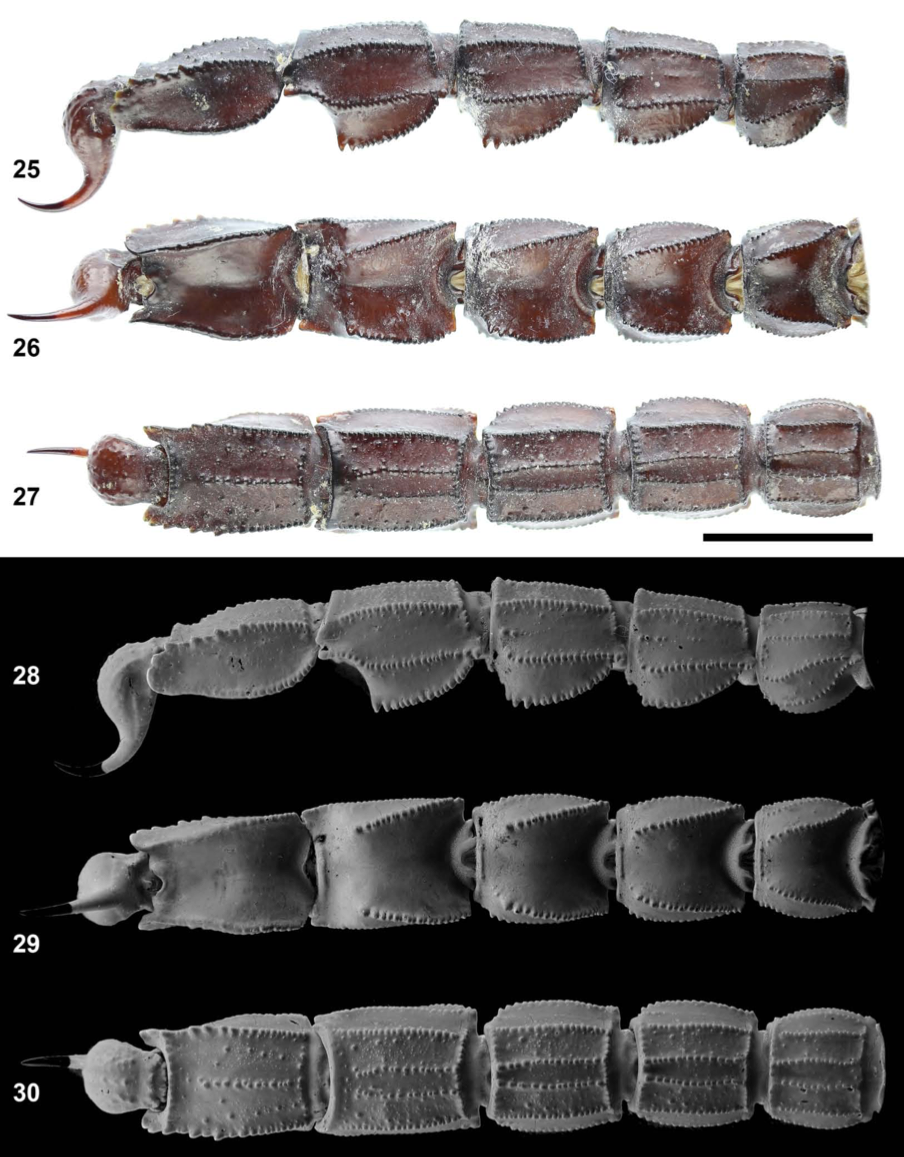
Figures 25–30: Androctonus turkiyensis sp. n., metasoma and telson of female paratype from the Şuayipşehir Village. Figures 25–30. Lateral (25, 28), dorsal (26, 29), and ventral (27, 30) views. Figures 25–27. Under white light. Figures 28–30. Under UV light. Scale bar: 10 mm.

Figures 31–36: Androctonus turkiyensis sp. n. Metasoma IV–V and telson. Figures 31–33. Male holotype in dorsal (31) ventral (32) and lateral (33) views. Figures 34–36. Female paratype from the Şuayipşehir Village in dorsal (34) ventral (35) and lateral (36) views. Scale bar: 10 mm.

Figures 37–50. Androctonus turkiyensis sp. n., male holotype, pedipalp segments. Chela internal (37), ventral (38), external (39) and dorsal (40) views. Femur and trochanter dorsal (41), internal (42), ventral (43) and external (44) views. Patella dorsal (45), external (46), internal (47) and ventral (48) views. Movable (49) and fixed (50) fingers dentition. Trichobothrial pattern is indicated by red circles. Scale bar: 10 mm.
intercarinal tegument finely granulose with irregular coarse granules dorsally, inner surface with few coarse granules; dorsointernal carinae with one spinoid granule distally. Patella with seven carinae, slender and straight; all carinae moderately strong, dorsointernal, dorsomedian, dorsoexternal, ventrointernal, ventromedian carinae granulose, ventromedian and ventrointernal carinae nearly smooth. Dorsointernal and ventrointernal carinae with one spinoid granule distally. Surfaces smooth with scattered fine granules. The chela is smooth, without carinae. Chela with manus wider than patella (Chela width/patella width=1.10); fingers are moderately elongated (movable finger/manus ratio=1.55), evenly curved. The movable fingers of pedipalps bear 14–16 (mostly 15) rows of granules and external and internal granules; the fixed fingers bear 14–16 (mostly 15) rows of granules, with external and internal accessory granules and three distal granules.
Measurements. See Table 1.
Affinities. The new species can be distinguished from the type-locality population of A. crassicauda by following characters:(a) General coloration of the new species is brown or dark brown, whereas in A. crassicauda it is black.
(b) Ventrolateral carinae of metasomal segment V with gradually increased granules posteriorly and 3–4 large and partly pointed large denticles, whereas A. crassicauda has moderate and gradually increased granules posteriorly and no large denticles.
(c) Dorsolateral carinae rounded with very swollen and large granules anteriorly, without granules posteriorly whereas A. crassicauda has pointed granules anteriorly.(d) Dorsolateral carinae of segments III-IV with moderate and rounded granules, granule size gradually increased posteriorly, with two large granules posteriorly, whereas A. crassicauda

Figures 51–64. Androctonus turkiyensis sp. nov., female paratype from the Şuayipşehir Village, pedipalp segments. Chela internal (51), ventral (52), external (53) and dorsal (54) views. Femur and trochanter dorsal (55), internal (56), ventral (57) and external (58) views. Patella dorsal (59), external (60), internal (61) and ventral (62) views. Movable (63) and fixed (64) fingers dentition. Trichobothrial pattern is indicated by red circles. Scale bar: 10 mm.
has large, pointed and comb-like granules, and granule size is only slightly gradually increased posteriorly without large posterior granules.(e) Carapace carinae and intercarinal area with large granules, whereas A. crassicauda has small granules.
Ecology. Crucitti (2003) studied ecology of this species under the name of Androctonus crassicauda. He reported that this species is abundant in village houses made of adobe (mud mixed with straw) or stones since walls of such houses have many deep holes. Besides, Crucitti (2003) reported that these scorpions are active after sunset at temperature not less than 30°C, and that they are psammophilous species that have close relationship with human habitat. My observations confirm that this species is psammophilous and has adapted to human settlements and is abundant on
walls of animal barns made of adobe or stone. It was also collected under stones and entrances of lateral rock crevices in steppe areas. On a night field trip, it was observed to use also abandoned rodent burrows. Crucitti (2003) reported that this species preys on gecko lizards and tenebrionid beetles. I also observed that this species hunts grasshoppers, Egyptian cockroaches (Polyphaga aegyptiaca), as well as other scorpions (Compsobuthus matthiesseni, Mesobuthus sp., juveniles of its own species; in captivity they also preyed on Scorpio kruglovi). Probably, the reason that this species is so abundant in human settlements is that the adobe and stone walls provide good hiding places. Another reason is the abundance of geckos and cockroaches in animal barns. Crucitti (2003) reported that this species searches for prey by wandering on the soil surface, inside and outside the walls of buildings. He also reported that this species hunted by

Figures 65–68. Androctonus turkiyensis sp. n., male holotype right legs I–IV, retrolateral aspect.

Figures 69–70. Comparison metasoma I–III and telson between Androctonus turkiyensis sp. n. (69, male holotype) and A. crassicauda (70, male neotype from Iran, Kashan).
“sit and wait” or “ambush hunter” strategies. I have observed individuals of this species sitting under stones and at the entrance of their burrows or abandoned rodent burrows with their pedipalps extended.
Acknowledgements
I wish to thank Abdulmüttalip Akkaya (Bursa, Turkey), Aziz Avcı (Department of Biology, Adnan Menderes University, Turkey), Abdulkadir Erdoğmuş (Şanlıurfa, Turkey), Alexander V. Gromov (Bingen am Rhein, Germany), Halil Koç (Department of Biology, Sinop University, Turkey), Mohammad Moradi (Department of Biology, University of Zanjan, Iran), Celal Öney (Department of History, Muş Alparslan University, Turkey), Mehmet Özkörük (Gaziantep, Turkey), Özgün Sipahioğlu (İstanbul, Turkey), İsmail Yağmur (Faculty of Medicine, Harran University, Şanlıurfa, Turkey), and Mehmet Zülfü Yıldız (Department of Biology, Adıyaman University, Turkey) for their help in field trips. I thank two anonymous reviewers for their help.
References
BIRULA, A. A. 1900. Beiträge zur Kenntniss der Scorpionenfauna Ost-Persiens. Bulletin de l’Académie Impériale des Sciences de St.-Pétersbourg, 12(1): 355– 375.
BIRULA, A. A. 1904. Miscellanea scorpiologica. VI. Ueber einige Buthus-Arten Centralasiens nebst ihrer geographischen Verbreitung. Annuaire du Musee Zoologique de I’ Academie Impenale des Sciences de St.- Petersbourg, 9: 20–27.
CRUCITTI, P. 1999. The scorpions of Anatolia: Bio- geographical patterns. Biogeographica, 20: 81–94.
CRUCITTI, P. 2003. Ricerche bio-ecologiche su Androctonus crassicauda nell’Anatolia sud-orientale. Bollettino della Società Entomologica Italiana, 135(1): 3–14.
CRUCITTI, P. & D. CICUZZA. 2001. Scorpions of Anatolia: Ecological patterns. Pp. 225–234 in Fet, V. & P. A. Selden (eds.). Scorpions 2001. In Memoriam Gary A. Polis. Burnham Beeches, Bucks: British Arachnological Society.
ÇALIŞKAN, F., V. QUINTERO-HERNÁNDEZ, R. RESTANO-CASSULINI, F.I. CORONAS- VALDERRAMA, G. CORZO & L.D. POSSANI. 2013a. Molecular cloning and biochemical characterization of the first Na+-channel α-type toxin peptide (Acra4) from Androctonus crassicauda scorpion venom. Biochimie, 95(6): 1216–1222.
ÇALIŞKAN, F., E. ERGENE, I. SOGUT, I. HATIPOGLU, A. BASALP, H. SIVAS & G. KANBAK. 2013b. Biological assays on the effects of Acra3 peptide from Turkish scorpion Androctonus crassicauda venom on a mouse brain tumor cell line (BC3H1) and production of specific monoclonal antibodies. Toxicon, 76, 350–361.
FET, V. & G. LOWE. 2000.Family Buthidae C. L. Koch, 1837. Pp. 54–286 in Fet, V., W. D. Sissom, G. Lowe & M. E. Braunwalder. 2000. Catalog of the Scorpions of the World (1758–1998). New York: The New York Entomological Society, 689 pp.
FRANCKE, O.F. 1977. Scorpions of the genus Diplocentrus from Oaxaca, Mexico (Scorpionida, Diplocentridae). Journal of Arachnology, 4: 145–200.
HENDRIXSON, B. E. 2006. Buthid scorpions of Saudi Arabia, with notes on other families (Scorpiones: Buthidae, Liochelidae, Scorpionidae). Fauna of Arabia, 21: 33–120.
HJELLE, J. T. 1990. Anatomy and morphology. Pp. 9-63 in: Polis, G.A. (ed.), Biology of Scorpions. Stanford, CA: Stanford University Press.
KRAEPELIN, K. 1891. Revision der Skorpione. I. Die Familie der Androctonidae. Jahrbuch der Hamburgischen Wissenschaftlichen Anstalten, 8: 1-144.
LEVY, G. & P. AMITAI. 1980. Fauna Palaestina. Arachnida I. Scorpiones. The Israel Academy of Sciences and Humanities, Jerusalem, 92 pp.
LOURENÇO, W. R. 2005. Nouvelles considérations taxonomiques sur les espèces du genre Androctonus Ehrenberg, 1828 et description de deux nouvelles espèces (Scorpiones, Buthidae). Revue suisse de Zoologie, 112(1): 145–171.
OLIVIER, G.A. 1807. Voyage dans l’Empire Othoman, l’Egypte et la Perse. Henri Agasse, Paris, 5.
17
ÖZKAN, Ö., S. ADIGÜZEL, S. YAKIŞTIRAN & A. FILAZI. 2006a. Study of the relationship between Androctonus crassicauda (Oliver, 1807; Scorpiones, Buthidae) venom toxicity and telson size, weight and storing condition. Journal of Venomous Animals and Toxins Including Tropical Diseases, 12: 297–309.
ÖZKAN, Ö., S. ADIGÜZEL, S. YAKIŞTIRAN, Y. CESARETLİ, M. ORMAN & K.Z. KARAER. 2006b. Androctonus crassicauda (Olivier 1807) scorpionism in the Sanlıurfa provinces of Turkey. Türkiye Parazitoloji Dergisi, 30 (3): 239–245.
ÖZKAN, Ö., C. AHMET & K. ZAFER. 2010. A study on the genetic diversity of Androctonus crassicauda (Olivier, 1807; Scorpiones: Buthidae) from Turkey. Journal of Venomous Animals and Toxins including Tropical Diseases, 16(4): 599–606.
ÖZKAN, Ö., S. KAR, E. GÜVEN & G. ERGUN. 2007. Comparison of proteins, lethality and immunogenic compounds of Androctonus crassicauda (Olivier, 1807) (Scorpiones: Buthidae) venom obtained by different methods. Journal of Venomous Animals and Toxins including Tropical Diseases, 13(4): 844–856.
POCOCK, R.I. 1895. On the Arachnida and Myriapoda obtained by Dr. Anderson’s collector during Mr T. Brent’s expedition to the Hadramaut, South Arabia, with a supplement upon the scorpions obtained by Dr. Anderson in Egypt and the Eastern Soudan. Journal of the Linnaean Society, 25: 292-316.
REIN, J.O. 2021. The Scorpion Files. Trondheim: Norwegian University of Science and Technology. Available from https://www.ntnu.no/ub/scorpion-files/, accessed 20.09.2021.
SIMON, E. 1872. Arachnides de Syrie rapportes par M. Charles Piochard de la Brulerie (Scorpions et Galeodes). Annales de la Societe Entomologique de France, (5), 2: 247-264.
STAHNKE, H.L. 1971. Scorpion nomenclature and mensuration. Entomological News, 81: 297–316.
TOLUNAY, M.A. 1959. Zur Verbreitung der Skorpione in der Türkei. Zeitschrift für angewandte Entomologie, 43(4): 366–370.
TOPRAK, S., A. PARMAKSIZ & N. ASLAN. 2019. Mitochondrial cytochrome oxidase subunit I-sequence variation in three scorpion species from southeast Turkey. Indian Journal of Animal Research, 53(2): 187– 191.
Yağmur: Androctonus turkiyensis sp. n. from Turkey
18
VACHON, M. 1947. Remarques préliminaires sur le faune des Scorpions de Turquie. Bulletin du Muséum national d’Histoire naturelle Paris, 19 (2): 161-164.
VACHON, M. 1948. Etudes sur les scorpions. III (suite). Déscription des scorpions du Nord de l’Afrique. Archives de l’Institut Pasteur d’Algérie, 27 (2): 134–169.
VACHON, M. 1951. A propes de quelques Scorpions de Turquie collectés par M. le Professeur Dr. Curt Kosswig, -Prof.KosswigtarafındanTürkiye’detoplananakrepler hakkında.İstanbulÜniversitesiFenFakültesiMecmuası, 16 (4): 341-344.
VACHON, M. 1974. Etude des caractères utilisés pour classer les familles et les genres de Scorpions (Arachnides). 1. La trichobothriotaxie en arachnologie. Sigles trichobothriaux et types de trichobothriotaxie chez les Scorpions. Bulletin du Muséum national d’Histoire naturelle Paris, 140: 857–958.
VOLSCHENK, E.S. 2005. A new technique for examining surface morphosculpture of scorpions. The Journal of Arachnology, 33(3), 820–825.
Euscorpius - 2021, No. 341
YAĞMUR, E. A. 2005. Gaziantep akrepleri (Ordo: Scorpiones) ve zoocoğrafik dağılışları. Yüksek Lisans Tezi, Gaziantep Üniversitesi Fen Bilimleri Enstitüsü, Gaziantep. 136 s.
YAĞMUR, E.A., H. KOÇ, S. KESMEZOĞLU & M. YALÇIN. 2007. Scorpions of Kilis Province, Turkey (Arachnida: Scorpiones), Serket, 10(3): 91–105.
YAĞMUR, E.A., M. YALÇIN & G. ÇALIŞIR. 2008. Distribution of Androctonus crassicauda (Olivier, 1807) and Buthacus macrocentrus (Ehrenberg, 1828) (Scorpiones: Buthidae) in Turkey, Serket. 11(1): 13–18.
YEŞİLYURT, F. 2005. Anadolu’daki Bazı Akreplerin Sistematiği ve Biyoekolojisi (Arachnida: Scorpionida). Kırıkkale Üniversitesi, Fen Bilimleri Enstitüsü, Yüksek Lisans Tezi. Kırıkkale. 80 s.
*THIS PUBLICATION IS PUBLISHED ON:

Comments